Silicone chin augmentation to balance a short or receding chin, by our surgical team
A short or receding chin makes the face look rounder and the jawline less defined. Chin augmentation with soft silicone balances the profile in a single procedure, with the incision placed beneath the chin or inside the mouth, whichever suits you.
Who chin augmentation suits
It suits people whose chin is short or recedes in profile, whose face looks round or lacks a defined jawline, and those who have had rhinoplasty but whose profile still looks unbalanced. The implant is an extra-soft Thai FDA-registered silicone designed for the chin, available in several sizes and shapes, which the surgeon selects and carves to hug the existing chin bone. For people whose main issue is a long chin or a jaw alignment problem, chin augmentation alone may not be the answer, and the doctor will say so frankly at the consultation. If you are not yet ready for surgery, chin filler lets you try the shape first.
External or intraoral incision
| Approach | Advantages | Limitations |
|---|---|---|
| External incision beneath the chin | A 1.5–2 cm incision hidden in the fold under the chin; no contact with saliva, so a lower infection rate and easy care | A small mark under the chin, visible when the head is tilted back, fading in 3–6 months |
| Intraoral incision | No external scar at all | Contact with saliva means a higher infection rate and strict oral hygiene; more swelling and discomfort when chewing for longer; a slightly higher risk of affecting the lower-lip nerve |
Preparing for surgery
- Basic blood tests before the day of surgery
- Stop aspirin, NSAIDs, fish oil, vitamin E and herbal supplements that increase bleeding for 2 weeks; no smoking or alcohol
- If you choose the intraoral incision, the mouth must be clean with no sores or infection
- No food or drink for 6 hours if intravenous sedation is to be used
Surgery day
Recovery
Aftercare in brief
- Cold compresses for the first 48 hours, then warm compresses to reduce bruising
- Sleep on your back with your head raised; no sleeping on your side or front for 2 weeks
- Eat soft food; avoid hard, chewy, spicy and very hot food for 1–2 weeks
- For intraoral cases, rinse with antiseptic mouthwash after every meal; no kissing or drinking through a straw in the first week
- Finish the full course of antibiotics; avoid smoking, alcohol and fermented foods for 2–4 weeks
- Do not press or massage the chin, and avoid chin straps and helmets with chin straps for 1 month
- No strenuous exercise for 2 weeks and no contact sports for 6 weeks. Attend every follow-up appointment
Possible risks include a haematoma under the skin, infection, a displaced or crooked implant, numbness of the chin tip and lower lip that is usually temporary but persists in a small number of cases, and slight thinning of the chin bone over the long term. Contact the clinic immediately if pain or swelling increases after day 3, the wound is red, hot or discharging pus, you have a fever, the chin is clearly asymmetric or the lower lip moves unevenly.
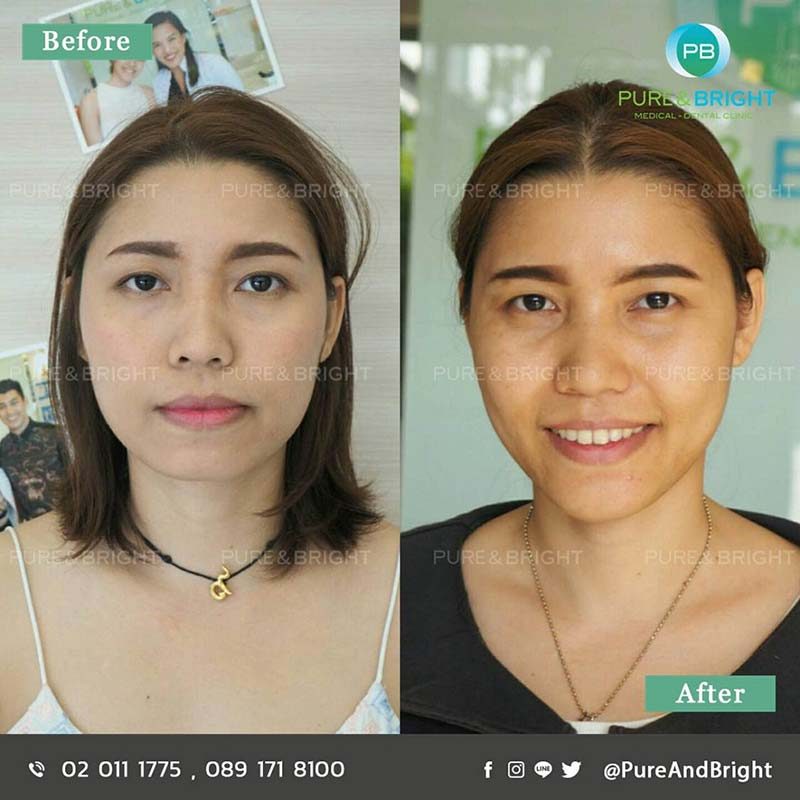
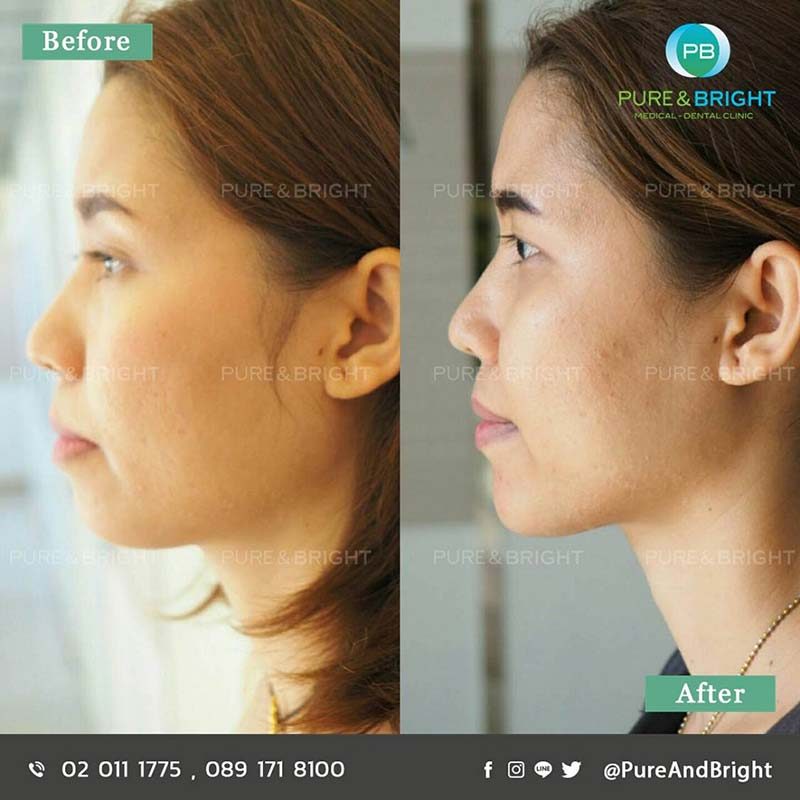
Results from our patients
Related services
Frequently Asked Questions
How does chin augmentation differ from chin filler?
Filler takes 20 minutes with no incision, but dissolves in 12–18 months and can only add a limited amount. Silicone gives a sharper jawline and lasts much longer, but requires surgery and 1–2 weeks of recovery. Many people try filler first and then decide on surgery.
Will the scar be visible?
With an intraoral incision there is no external scar at all. With an incision beneath the chin there is a 1.5–2 cm line in the fold under the chin, visible only when you tilt your head back and fading over 3–6 months. The doctor will help you weigh the pros and cons of each approach.
Will the numbness in my chin go away?
Numbness is caused by swelling pressing on the lower-lip nerve. In most people it gradually improves over 2–8 weeks; in a small number it lasts longer. The doctor monitors it at every follow-up.
Can a chin implant move?
In the first 2–4 weeks it can shift if pressed or knocked, which is why the compression wrap is used and sleeping face-down is avoided. After that, scar tissue holds the implant in place. If it is found to be off-centre, the doctor will arrange a repositioning.
 WhatsApp
Related services
Cosmetic Surgery
Nose, chin, eyes, dimples, lips, breasts, fat grafting and liposuction by our surgical team
Skin & Laser
Melasma, freckles, dark spots, acne, acne scars, pores, hair removal and mole removal with multiple laser systems
Injectables & Skin Rejuvenation
Anti-wrinkle injections, HA filler, skin boosters, collagen stimulators, PRP and fat-dissolving injections