Dimple creation: a dimple when you smile, in a 30-minute procedure with the incision hidden inside the mouth
Dimples form where the cheek muscle is attached to the skin. Dimple creation reproduces this mechanism with an anchoring suture placed from inside the mouth, leaving no scar on the face. It is done under local anaesthetic and you go home straight afterwards.
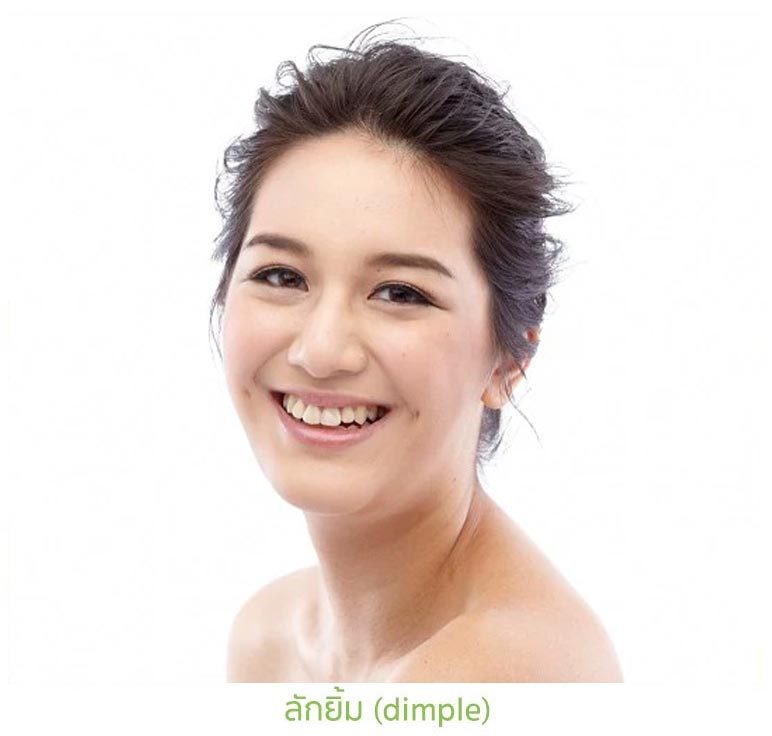
How dimples form
People born with dimples usually have a smile muscle (zygomaticus major) that splits into two bands, so when they smile the muscle pulls the cheek skin inwards. Dimple creation makes an anchor point between the inner cheek skin and this muscle with a suture placed from inside the cheek, so the outer skin has no wound. The classic position is where a vertical line from the outer corner of the eye meets a horizontal line from the corner of the mouth, but the doctor will have you smile and press the spot in front of a mirror to find the position that looks most natural on your face. It suits people with moderately full cheeks and is not suitable for those with very hollow cheeks or an infection in the mouth.
Two dimple styles
| Style | Appearance | Suits |
|---|---|---|
| Dot dimple | A small round indentation, 3–5 mm, in the middle of the cheek | A slim or oval face, wanting a soft look |
| Line dimple | A vertical indentation 8–12 mm long, similar to the natural dimples common in Thai faces | Fuller cheeks, a round face, or wanting it clearly visible in a wide smile |
Preparation
- Tell us about any bleeding disorders, medicines you take and any allergy to local anaesthetic
- Stop aspirin, fish oil and vitamin E for 1 week, unless your regular doctor advises otherwise
- Keep your mouth clean, with no ulcers or oral infection on the day of the procedure
- No smoking or alcohol for 1 week before and after
The procedure day
How the dimple changes over time
Aftercare
- Rinse with antiseptic mouthwash after meals and before bed for 1 week
- Eat soft food that is not very hot or spicy, and avoid chewy food for 5–7 days
- Cold compresses on the outside of the cheek for the first 2 days
- Do not press, massage or suck the cheeks hard, and no kissing for 1 week
- Practise gentle smiling from day 3 so the anchor settles along your real smile
Possible risks include wound infection, slight asymmetry, a dimple that is too shallow or fades quickly and needs an additional suture, and, rarely, a deep dimple that remains at rest. Contact the clinic immediately if the cheek becomes more swollen, red and hot after day 3, there is pus or a bad taste in the mouth, you have a fever or a hard lump is growing.
Frequently Asked Questions
Will the dimple be visible all the time?
For the first 6–8 weeks it shows even at rest. After that, in most people it remains visible only when smiling. Some people still see a faint dimple at rest if their cheeks are thin, and the doctor explains this possibility before the procedure.
Can the dimple disappear completely?
In some people the anchor loosens until the dimple is very shallow, especially those with thick cheeks or sutures that dissolve quickly. It can be re-sutured after 3 months, and the clinic sets out the conditions for a repeat procedure at the consultation.
Does it hurt? How many days of recovery?
Local anaesthetic is used, so you feel only tightness during the procedure. Afterwards, chewing is uncomfortable for 3–5 days. You can work the next day, but the cheek will be swollen and the dimple deep enough for people around you to notice for about 1 week.
What if I later decide I no longer want a dimple?
Within the first month the anchoring suture can be cut from inside the mouth to release the dimple. Once scar tissue has formed, reversal is harder and a faint mark may remain, so be sure before you proceed.
 WhatsApp
Related services
Cosmetic Surgery
Nose, chin, eyes, dimples, lips, breasts, fat grafting and liposuction by our surgical team
Skin & Laser
Melasma, freckles, dark spots, acne, acne scars, pores, hair removal and mole removal with multiple laser systems
Injectables & Skin Rejuvenation
Anti-wrinkle injections, HA filler, skin boosters, collagen stimulators, PRP and fat-dissolving injections